Getting Started
When you sign up for a MUN, you likely have some choice in the council you want to join. Every council has a topic to be debated upon.
Most conferences release a prospectus that details the councils and topics for each edition.
Receiving your allocations
About a month before the conference, you will receive an email containing your council and allocation.
You have signed up for a MUN and received an email from the organisers.
Council: United Nations Educational, Scientific and Cultural Organization (UNESCO)
Topic: Press Freedom
Allocation: China
This means you will (pretend to) represent the government of China in UNESCO, debating the topic of press freedom.
If you signed up for a double-delegate council, you will also receive the name of your co-delegate.
A council where two delegates represent a country, instead of one.
For all intents and purposes, you will work together with your co-delegate in every part of the conference. Awards are given as a delegation, meaning both you and your co-delegate are considered as a pair for awards.
Colloquially, Singaporeans call co-delegates their "double-del", or "ddel" (pronounced "dee-dell").
Welcome email
A few days after receiving your allocations, you will receive a welcome email from the Dais. The email should contain the following information:
- Council email address
- Deadline for your position paper
- Conference details (e.g. locations, schedules)
The email should also attach the following documents:
- Topic Guide
- Rules of Procedure
- Academics Guide
Topic Guide
The topic guide (or study guide) is a document containing useful information for delegates. It contains background information on the topic to give delegates a place to start for their research. The topic guide will also specify the scope of debate — what and what not to debate about. It also contains information such as proposed solutions and key stakeholders.
Resolutions: The end of the debate
United Nations resolutions are the formal expression of the opinion or will of the organs which adopt them.
This sounds like word vomit to me. For all intents and purposes in MUN, a resolution is a document containing the solutions that the council has debated on and agree to support. Debate in MUN is simply a means to an end, and that end is the resolution.
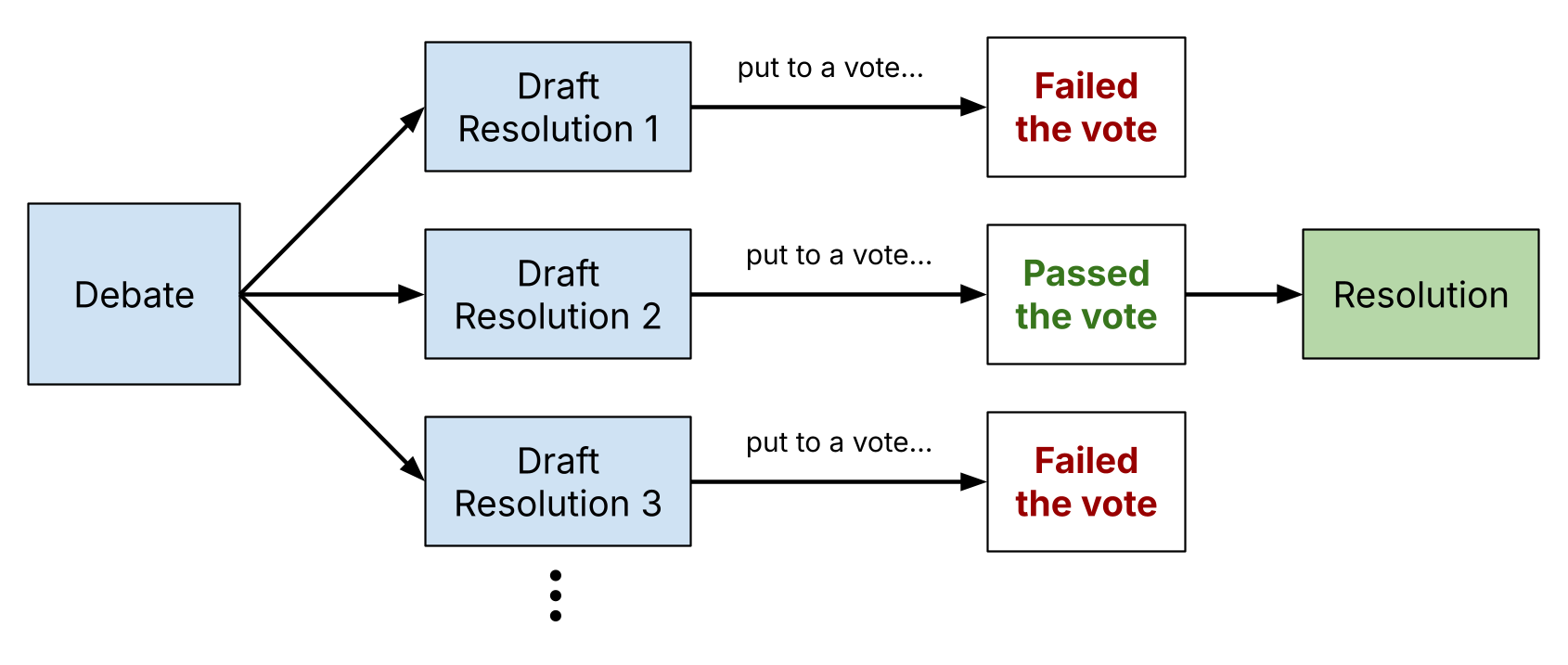
There are often disagreements between delegates in a council. During the debate, delegates submit draft resolutions, and these are put to a vote. Every delegate can vote for or against each draft resolution, or abstain from the vote.
Draft resolutions that pass the vote become full-fledged resolutions.
Questions a resolution must answer (QARMA)
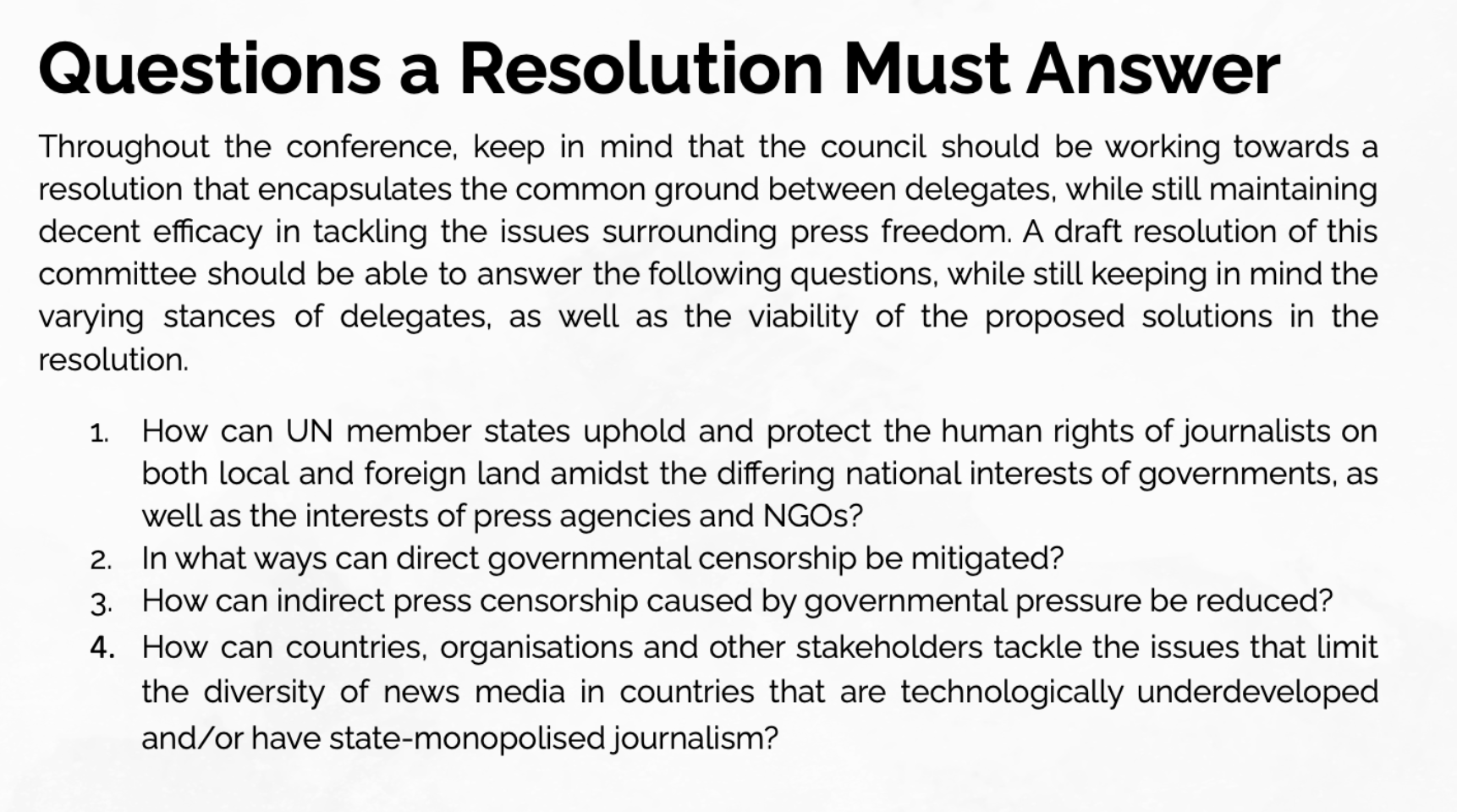
The topic guide often contains questions a resolution must answer (QARMA). Draft resolutions written by delegates during debate should answer these questions.
My friends and I wrote this QARMA for the topic of press freedom when we chaired UNESCO.
In hindsight, it's lowkey word vomit.