Solutions
Debating an issue is fun and all, but we risk being labelled “all talk, no action”. We need to propose solutions that answer the QARMA set out in the topic guide.
Council mandates
Most councils can only pass resolutions that are not legally binding. These councils are often called General Assembly (UNGA) councils.
In the United Nations, the only council that can pass legally binding resolutions is the Security Council (UNSC).
Councils outside the UN may be legally binding on member states, such as the African Union. Check your council's mandate!
The powers that an organisation has.
Most UN councils have mandates that are non-legally binding, meaning that decisions made are merely suggestions to countries. For example, UNESCO may suggest that countries promote press freedom, but countries may choose not to follow these suggestions.
Only the United Nations Security Council (UNSC) has a legally binding mandate, meaning the UNSC can make decisions that members must follow.
General Assembly resolutions
The mandate of the UNGA allows it to pass resolutions that
- Represent the views of the member states of the council, and
- Recommend actions and policies for member states to follow.
Member states are free to not follow the recommendations.
Here are some recommendations from an actual UNGA resolution regarding press freedom.
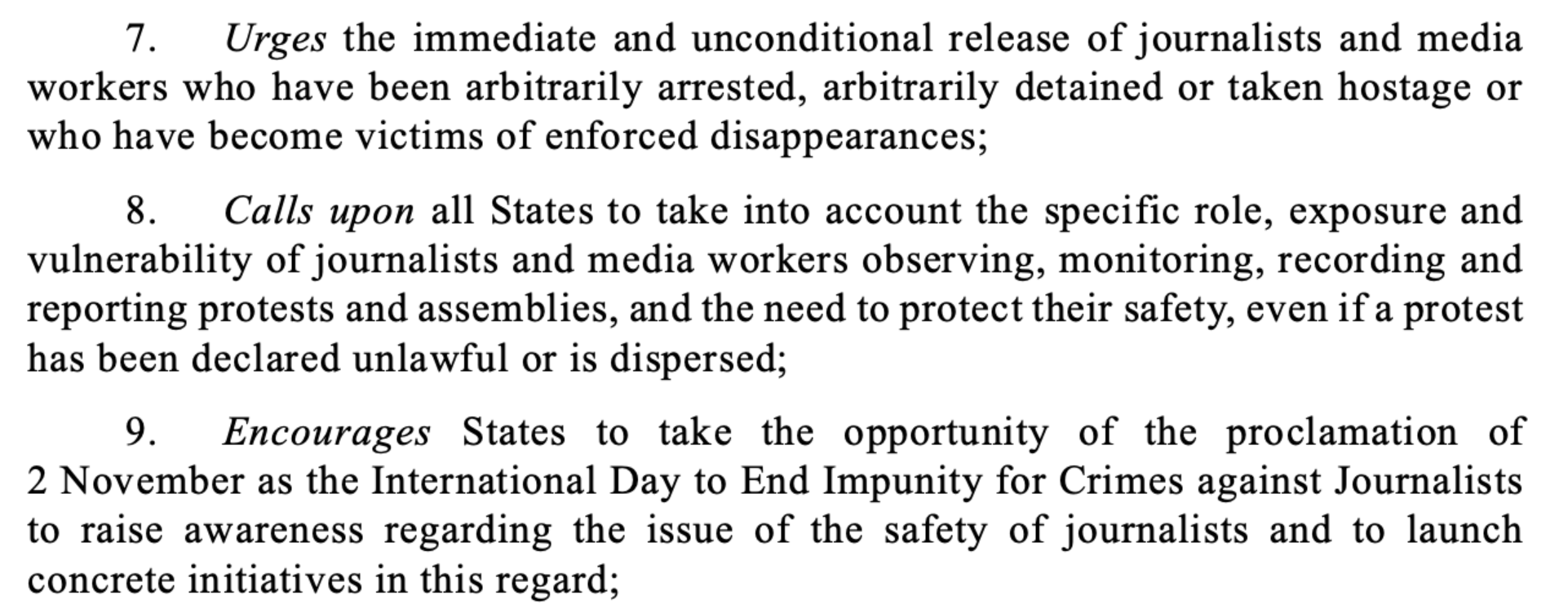

Notice the verbs in italics. These verbs can only recommend actions that countries can take. Verbs such as “declares” and “demands” cannot be used in non-binding resolutions.
Security Council resolutions
The United Nations Security Council (UNSC) may pass both legally binding and non-binding resolutions. These resolutions can mandate actions such as sanctions, military interventions, or ceasefires.
Member states that do not follow suit may face retaliation from other states, including sanctions and military action.
Common types of solutions in MUN
We aren’t actually representatives of countries. This gives us the flexibility of proposing solutions that may not actually work, but sound like they work.
These are some types of solutions frequently proposed in MUNs:
- Direct actions — e.g. calling upon all states to release imprisoned journalists.
- Frameworks — e.g. establishing the Framework for Press Freedom (FPF) for countries to follow to improve their press freedom.
- Groups/organisations with fun acronyms — e.g. founding an organisation called the Alliance for the Conservation of Reporting, Outreach, and News Yielding Media (ACRONYM) which…
Establishing frameworks and organisations are common in MUN — this does not mean they are necessarily good solutions. However, they give beginner delegates a starting point. That being said, solutions are never cookie-cutter, meaning every topic will have unique solutions with unique considerations.
Establishing a so-and-so framework is not as simple as it sounds. Suppose a draft resolution reads:
Establishes the Framework for Press Freedom (FPF), as follows:
- Third-party assessment on press freedom index
- Domestic deliberation on press freedom measures
- Domestic implementation on press freedom measures
- Third-party verification on press freedom measures
To many beginners, this sounds great — a four step framework for press freedom! However, this example is too vague and needs details for it to be effective. What does each phase entail? Who is involved in each phase? What is the purpose of each phase?
Establishing a so-and-so organisation requires tact as well.
- What is the organisation's mandate?
- What is the organisation's structure?
- Who leads the organisation?
- Who gets to be a member of the organisation?
- How is the organisation funded? Who handles funding?
- etc.
There are unique questions that present themselves with each unique solution proposed. To reiterate, solutions are never cookie-cutter, because cookie-cutter solutions lack depth and rigour.
Where to begin
We are not experts in whatever topic we are debating. Therefore, we defer to actual experts and what they say. Research what think tanks and other organisations propose, as well as past actions by governments and international bodies.
Remember: you do not need to come up with solutions from scratch. You can adapt what is already proposed or take inspiration from a past action. Again, we are not experts — we are mere students trying to get a better grasp on some current affairs topic.
When researching the above, keep in mind the rationale behind any detail of a solution. You want to be able to defend the solution you raise to other delegates — if you are unable to justify a part of the solution, you may not be able to sway other delegates to support your solution.