Motions and Voting
Different delegates have different preferences and intentions. If the delegate of France wishes for an Unmoderated Caucus, but the delegate of China wants a Moderated Caucus instead — who gets what they want?
Motions are formal requests that affect the entire council, submitted by delegates to the Dais.
Motions need to pass for them to be carried out. To pass a motion (heheh…), a majority of the delegates in the council must vote for the motion.
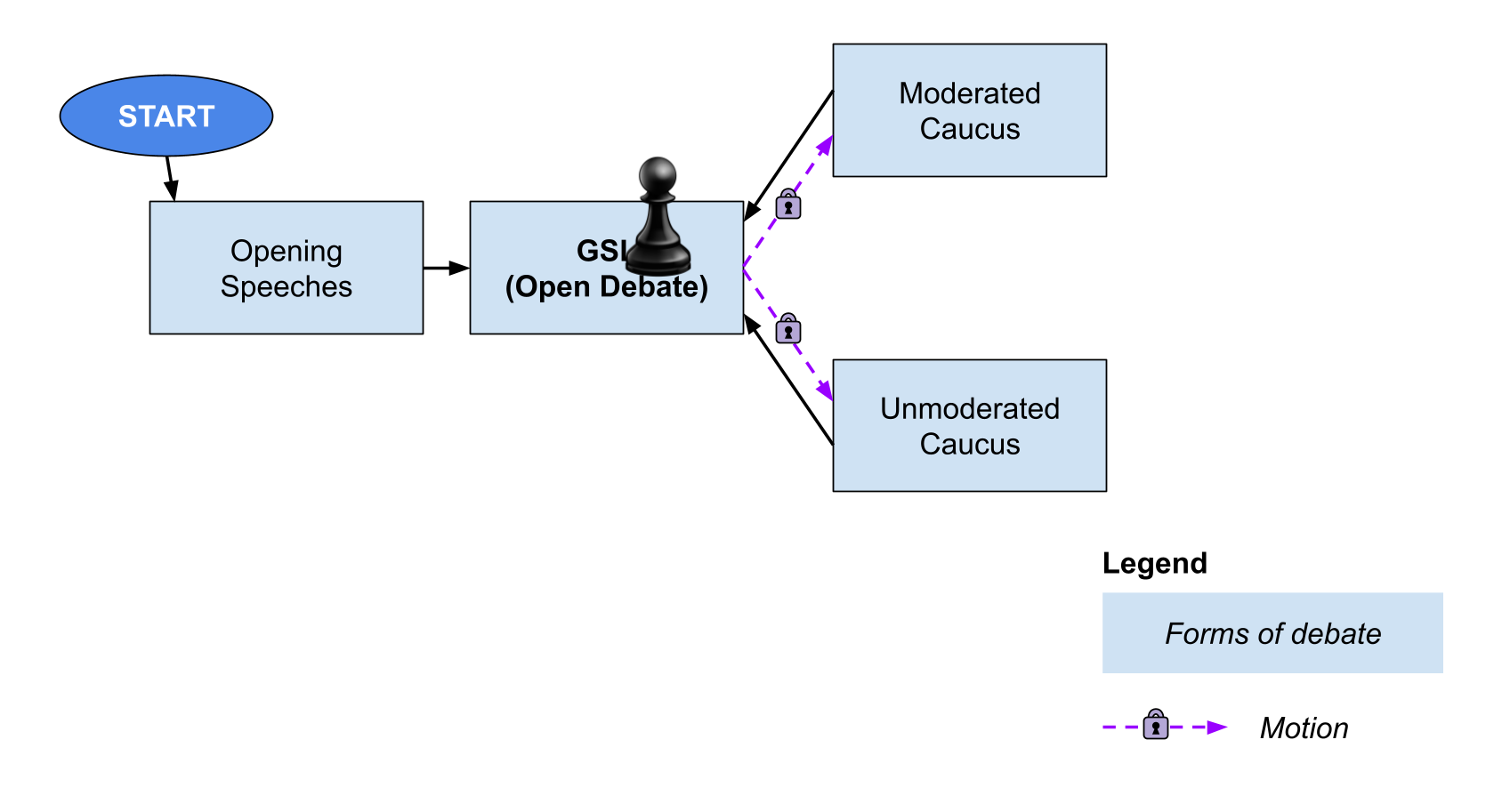
There are two types of motions:
- Procedural motions — Motions to proceed council happenings.
- Substantive motions — Motions to officially enact something.
Most motions are procedural motions.
For each of the motions, there is a type of majority that must be reached.
The majority required for a procedural motion to pass.
Most often: More than half (>50%) of the council must vote for the motion.
The majority required for a substantive motion to pass.
Most often: At least two-thirds (≥66.6…%) of the council must vote for the motion.
We have covered two motions so far:
- Motion for a Moderated Caucus
- Motion for an Unmoderated Caucus
Both these motions are procedural motions. This means that a simple majority must be reached in order for the motion to pass.
If a simple majority is not reached, then the motion does not pass. The council remains in the GSL.
Procedural Votes: How to vote
Raise your placard when the chairs ask for those voting for or against the motion. You must vote.
Most councils force delegates to either vote for or against a procedural motion. This means you cannot abstain from the vote.
- The chairs will ask delegates who vote for the motion to raise their placards.
- Then, the chairs will ask delegates who vote against the motion to raise their placards.
- Lastly, the chairs will tally the votes to ensure that the total number of votes is consistent with the number of delegates present in the council. If there is a discrepancy, the vote will be carried out again.
Procedural Votes: Seconds and objections
To speed up the process, chairs will quickly check if there are delegates voting for and against — without counting the votes.
Before the actual procedural vote, the chairs will call for seconds and objections.
- If you intend on voting for the motion, you can raise your placard to second the motion.
- If you intend on voting against the motion, you can raise your placard to object to the motion.
It is not compulsory to second or object to a motion. The delegate who raised the motion cannot second or object to their own motion.
In practice, the chairs will spend about 5 seconds calling for seconds and objections, as a quick litmus test to see if a vote is actually needed.
Dais: Before we vote on the motion, are there any seconds?
[Some delegates raise their placards.]
Dais: Objections?
[No delegate raises their placard.]
Dais: Seeing as there are only seconds and no objections, this motion automatically passes.
List of procedural motions not related to Draft Resolutions
This list of motions is non-exhaustive. There are more motions than this.
- Motion for a Moderated Caucus
- Motion for an Unmoderated Caucus
- Motion to Extend Unmoderated Caucus — to extend the time for the current Unmoderated Caucus.
- Motion to Adjourn Debate — to end the entire debate. Used only at the end of the last day. Usually voted on symbolically.
- Motion to Suspend Debate — to end the debate for the day. Used only at the end of the day, except for the last day. Usually voted on symbolically.
- Motion to Change the Speaking Time — to change the speaking time on the GSL.
- Motion to Table the Question — to move the debate onto the second topic (if any) immediately.
Here’s how our board game looks right now, with all the motions we’ve covered so far.
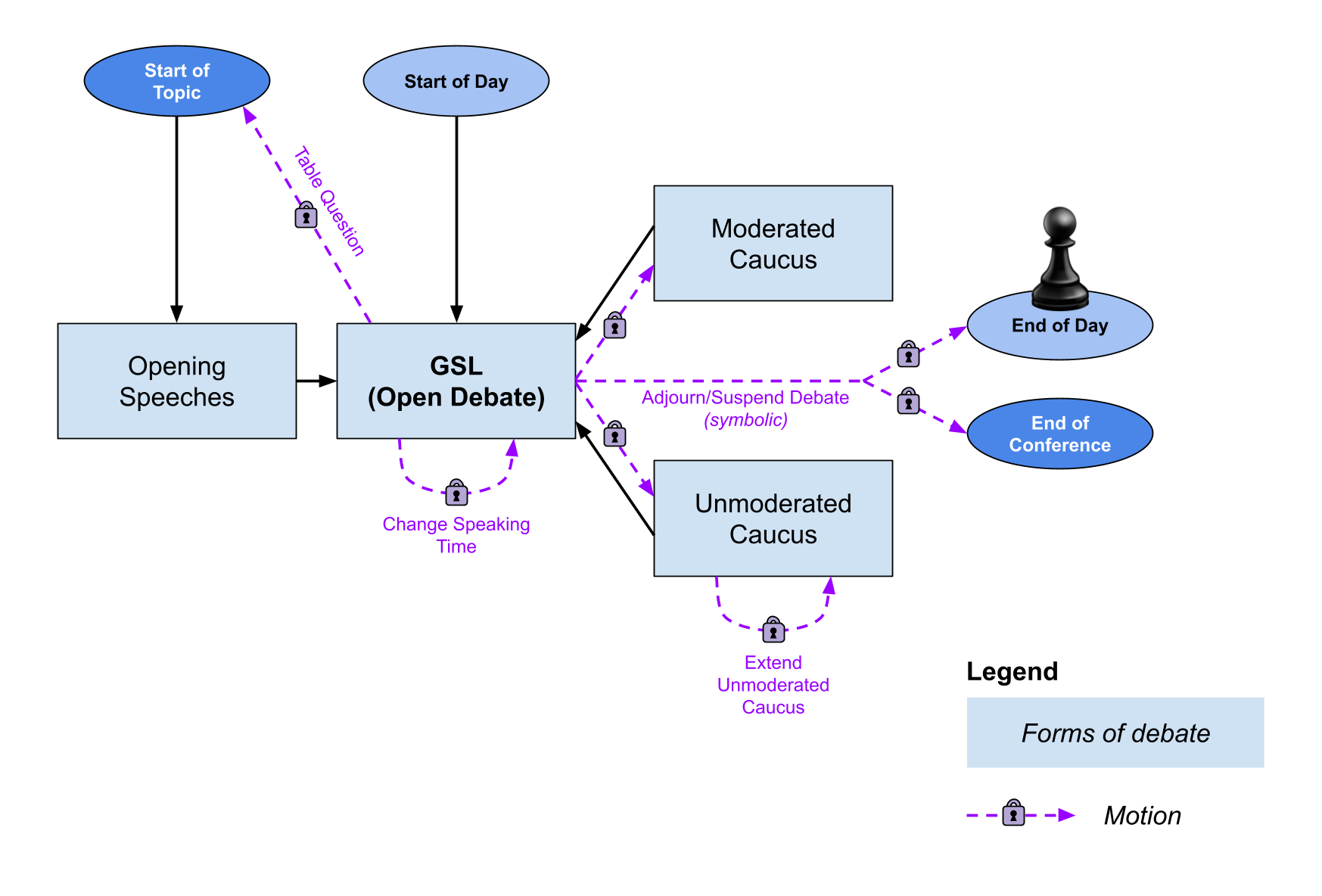
It looks incredibly messy, so we’ll remove the following for simplicity:
- Motions rarely encountered
- Symbolic motions (adjourning and suspending debate)
- End of day, and end of conference