Amendments
Perhaps you support most of a Draft Resolution, but there is just one clause that you simply cannot agree with. Instead of waiting for the vote to be divided by question, you can submit an amendment.
An amendment is a document stating how you wish a Draft Resolution could be changed.
There are two forms of amendments:
- Friendly Amendments 🙂
- Unfriendly Amendments 😡
Both forms have the same format. The format of amendments are generally not very strict. I’ve gotten away with using strikethrough markup, for example.
Automatic tabling of Draft Resolution
Regardless of the type of amendment, if 50% or more of the operative clauses have been amended, the Draft Resolution is automatically tabled.
In my humble opinion, this is a really dumb rule. It makes passing a Draft Resolution that many delegates support way less efficient.
This rule is separate from the 50% rule when dividing the vote by question.
Friendly Amendments
If your amendment is supported by all sponsors of the Draft Resolution, your amendment is considered friendly. Friendly Amendments are immediately enacted once submitted to the Dais.
Different MUNs have different processes for accepting Friendly Amendments — check the Rules of Procedure. Some MUNs want the signatures of all sponsors on notepaper, while other MUNs request for all sponsors to be cc’d in the email when submitting the document.
Unfriendly Amendments
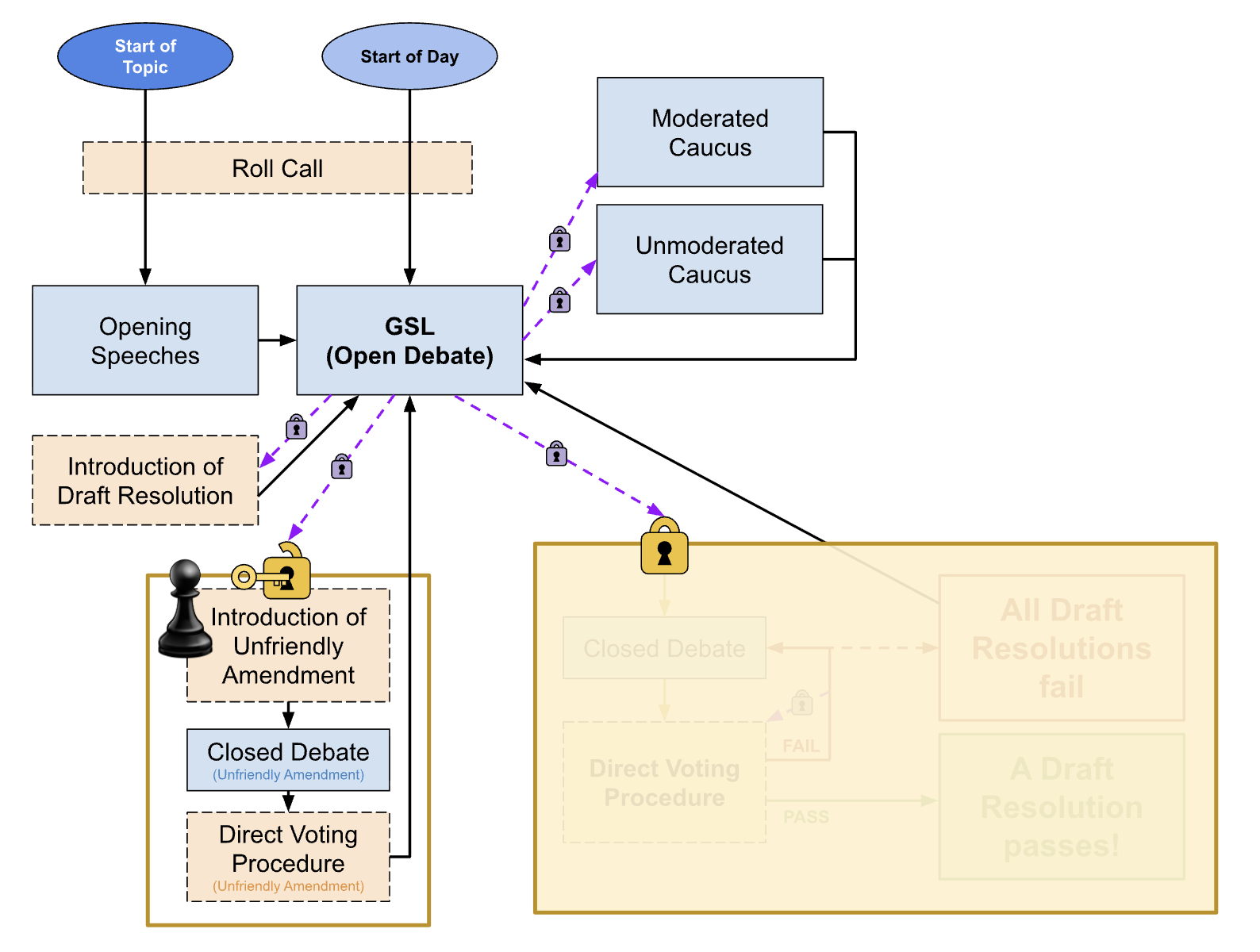
If at least one sponsor does not support your amendment, your amendment is considered unfriendly. Unfriendly Amendments are substantively voted on by the entire council through a Direct Voting Procedure.
To introduce an unfriendly amendment, you must raise a motion to introduce an Unfriendly Amendment. This motion must pass with a simple majority.
Closed debate (Unfriendly Amendments)
After the motion to introduce an unfriendly motion passes, the council will move into a closed debate on the unfriendly amendment. The closed debate takes the same format as for Draft Resolutions — two delegates speaking for, two delegates speaking against.
Direct Voting Procedure (Unfriendly Amendments)
Then, the council will move into a Direct Voting Procedure for your unfriendly amendment. Abstentions are in order unless a motion to divide the house is passed. If the vote fails, delegates may raise a motion to divide the house or divide the question.