Direct Voting Procedure
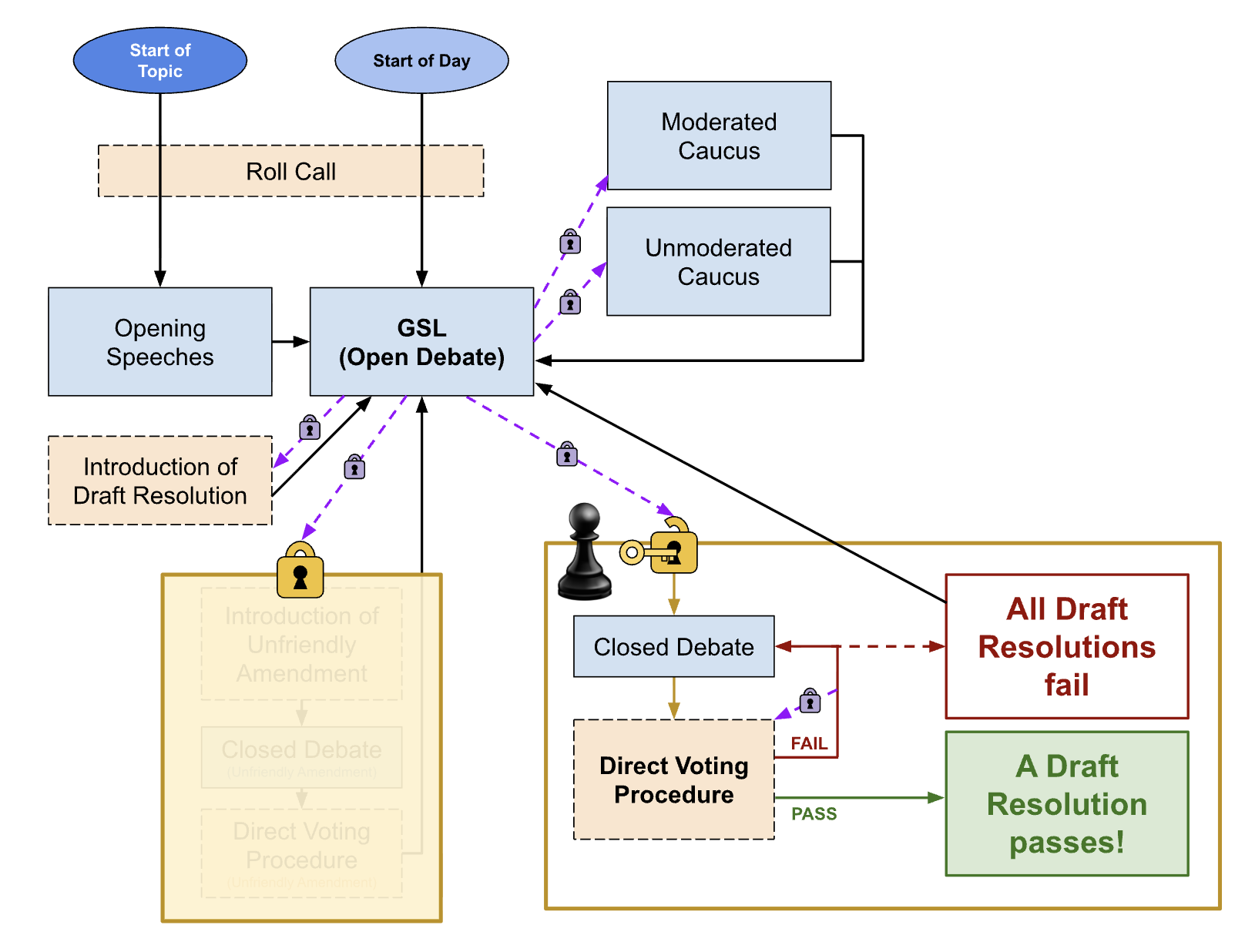
Delegates can raise a motion to move into Direct Voting Procedure during Open Debate. All Draft Resolutions that have been introduced thus far will be voted on.
Draft Resolutions are voted on in the order that they were introduced. Before voting on a Draft Resolution, a closed debate is held on the Draft Resolution.
You can change this with a motion to reorder Draft Resolutions.
You will have to state the new order you want the Draft Resolutions to be voted in. I’ve never actually seen this motion being raised before — I think many delegates forget about the existence of this motion.
Closed debate
Before the council votes on a Draft Resolution, the council will hold a closed debate on the Draft Resolution.
Two speakers who support the Draft Resolution and two speakers who do not support the Draft Resolution will speak during the closed debate — in alternating support.
In practice, the sponsors of the Draft Resolution usually speak for the Draft Resolution. There is no yielding during the closed debate.
Draft Resolution 1 was introduced first in this council. Therefore, Draft Resolution 1 will be voted on first. Before Direct Voting Procedure on Draft Resolution 1, the council moves into closed debate on Draft Resolution 1.
Dais: We will now hold a closed debate on Draft Resolution 1. Delegates wishing to speak for Draft Resolution 1, please raise your placards.
[Denmark and Finland raise their placards.]
Dais: Delegates wishing to speak against Draft Resolution 1, please raise your placards.
[China and Russia raise their placards.]
Therefore, the speakers of the closed debate are:
- Denmark (for)
- China (against)
- Finland (for)
- Russia (against)
Substantive Vote: Direct Voting Procedure
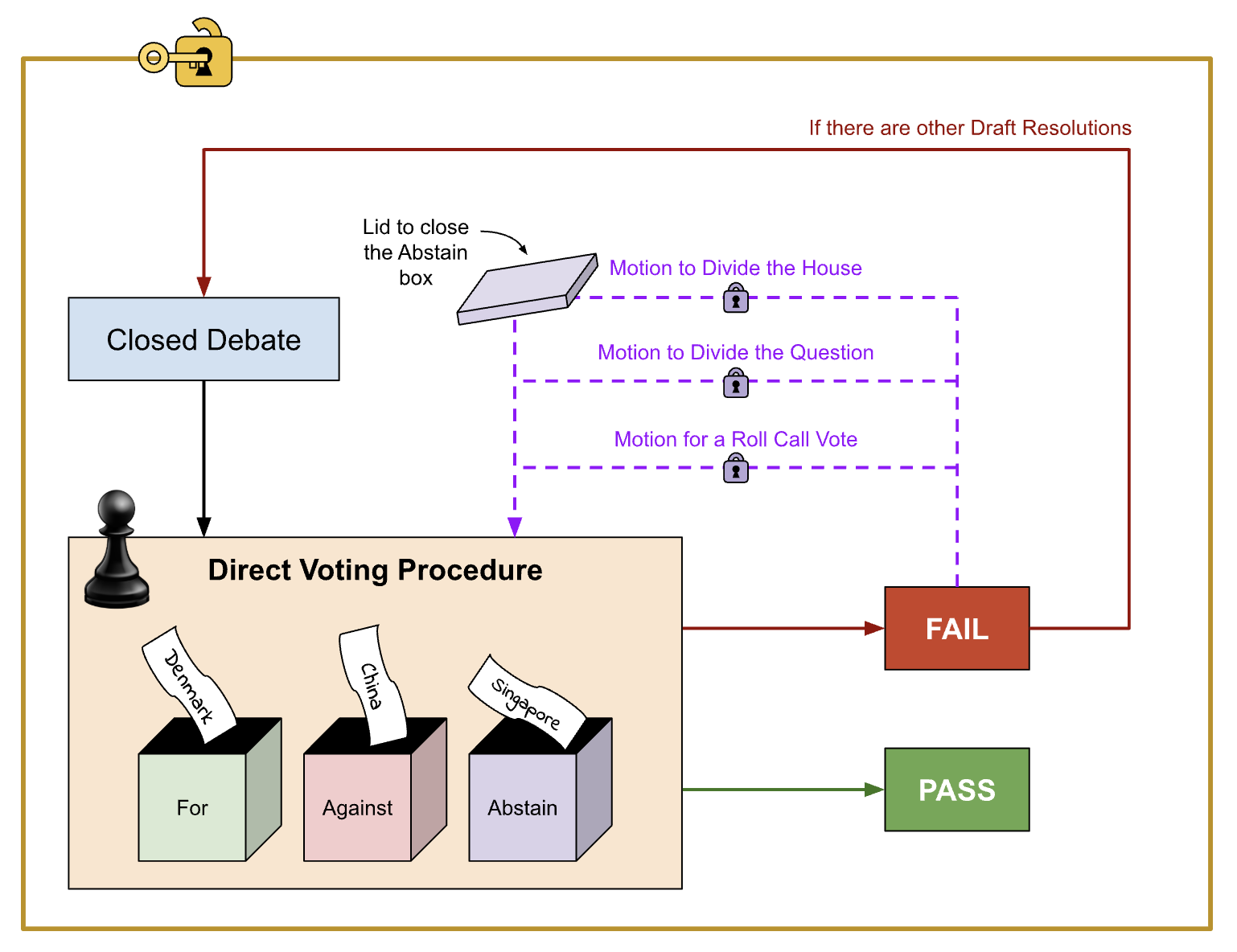
The note-passers in the council will lock the doors. Delegates who are not present in the council by this point will not be allowed to vote. In other words, don’t go to the toilet during closed debate.
Note-passing is also not in order.
During Direct Voting Procedure, delegates who are present and voting must raise their placards to vote in one of three ways:
- Vote for the Draft Resolution.
- Vote against the Draft Resolution.
- Abstain from the vote.
The chairs will tally the votes to ensure that every delegate who is present and voting has voted.
Direct Voting Procedure is a substantive vote. The council must reach a two-third majority (ignoring abstentions) for the Draft Resolution to pass.
If the Draft Resolution passes, the council can celebrate! 🥳
If the Draft Resolution fails, there are three motions available to try and salvage the vote. All three motions are procedural and require a simple majority to pass.
- Motion to Divide the House
- Motion to Divide the Question
- Motion for a Roll Call Vote
If at least one of these motions passes, the council moves back into Direct Voting Procedure on the Draft Resolution that had just failed.
The effects of these motions can stack and apply simultaneously. In other words, a division of the house, division of the question, and a roll call vote can theoretically be active simultaneously.
Direct Voting Procedure has just elapsed. The votes are as follows.
For: 11 (64.7%)
Against: 6 (35.3%)
Abstain: 3
The vote did not reach substantive majority (≥66.7%). Therefore, the Draft Resolution fails.
Dais: Are there any motions from the floor?
[Denmark raises their placard.]
Dais: Delegate of Denmark, please state your motion.
Denmark: Motion to divide the house.
Dais: That is in order.
Dividing the house
Delegates cannot abstain from the vote.
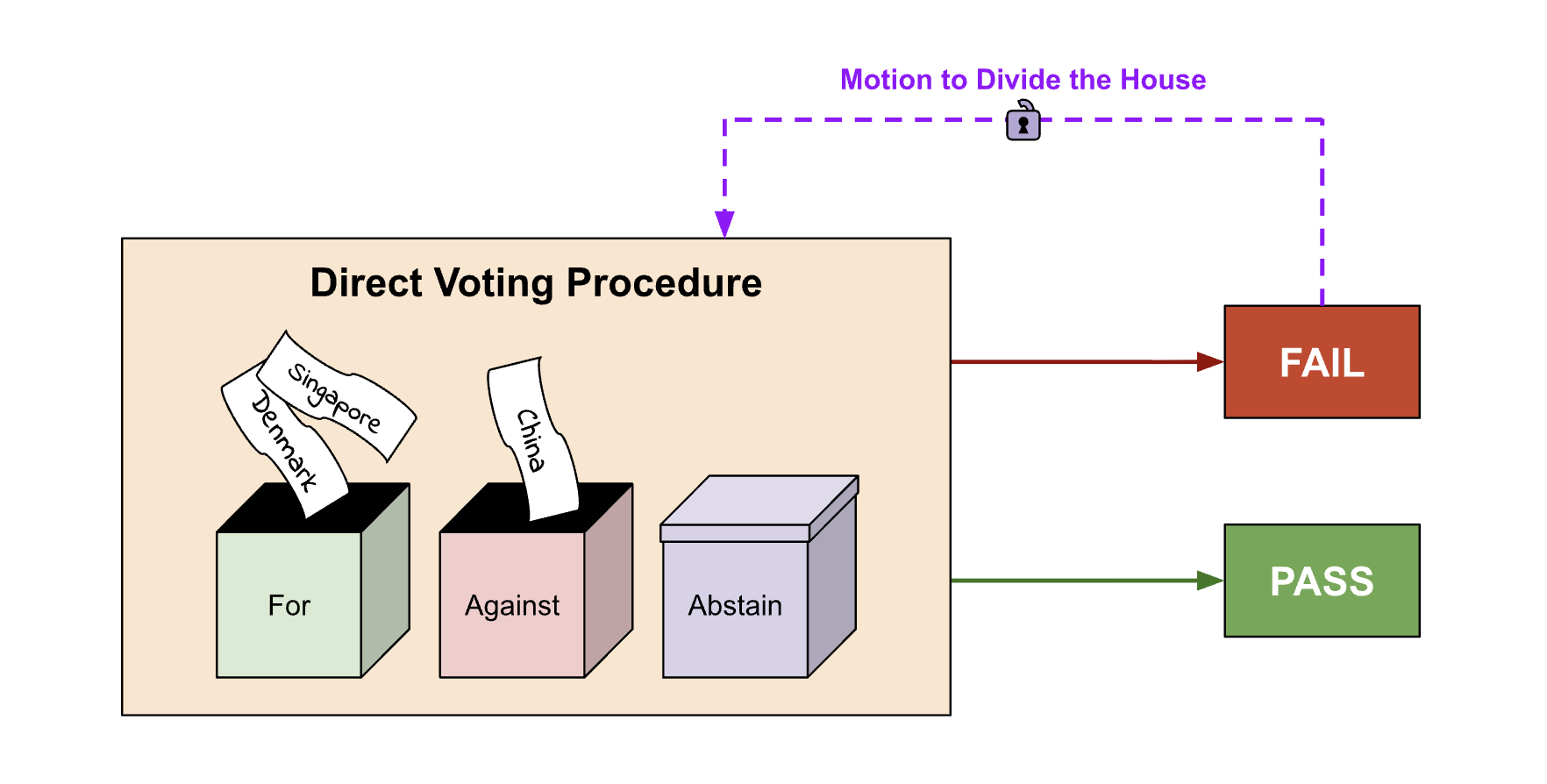
Delegates who are present and voting cannot abstain from the vote. Delegates must vote for or against the Draft Resolution. This is often used when the vote is extremely close to the substantive majority, where the number of delegates who abstained could possibly swing the vote.
In practice, sponsors of a failed Draft Resolution would often raise this motion whenever possible. However, it is rare that this motion has an effect on the outcome.
Direct Voting Procedure has just elapsed. The votes are as follows.
For: 11 (64.7%)
Against: 6 (35.3%)
Abstain: 3
The vote did not reach substantive majority (≥66.7%). Therefore, the Draft Resolution fails.
If the three delegates who abstained had instead voted for the Draft Resolution, this is what the results would have looked like.
For: 11+3 (70%)
Against: 6 (30%)
The vote would reach substantive majority (≥66.7%) and the Draft Resolution would pass.
Hence, a motion to divide the house could be used here to try and swing the vote.
Dividing the question
There will be a vote for each operative clause/article of the Draft Resolution.
Sometimes, delegates vote against a Draft Resolution due to certain problematic sections. Had these problematic sections been removed, these delegates may actually have voted for the Draft Resolution.
When a motion to divide the question is raised, it must be specified whether the Draft Resolution should be divided by clause or by article.
Delegates will now vote for each individual operative clause or article. This means the voting process is repeated for however many operative clauses or articles there are.
If at least 50% of the clauses/articles fail, the Draft Resolution automatically fails.
Dais: Are there any motions from the floor?
[Norway raises their placard.]
Dais: Delegate of Norway, please state your motion.
Norway: Motion to divide the question.
Dais: By clause or article?
Norway: By article.
Dais: That is in order.
Suppose the Draft Resolution has five articles.
- Article I: Housekeeping
- Article II: Safety of Journalists
- Article III: Prevention of Direct Censorship
- Article IV: Prevention of Indirect Censorship
- Article V: Constitutional Amendments for Freedom of Expression
The delegate of Norway has motioned to divide the question by article, and the motion is passed. The Dais carries out a vote for each article separately.
- [PASSED] Article I: Housekeeping
- [FAILED] Article II: Safety of Journalists
- [FAILED] Article III: Prevention of Direct Censorship
- [FAILED] Article IV: Prevention of Indirect Censorship
- [AWAITING VOTE] Article V: Constitutional Amendments for Freedom of Expression
The Dais has carried out a vote for the first four articles. Even before reaching Article V, more than 50% of the articles have failed. Therefore, the Draft Resolution automatically fails. Article V is not voted on.
Suppose the Draft Resolution has five articles.
- Article I: Housekeeping
- Article II: Safety of Journalists
- Article III: Prevention of Direct Censorship
- Article IV: Prevention of Indirect Censorship
- Article V: Constitutional Amendments for Freedom of Expression
The delegate of Norway has motioned to divide the question by article, and the motion is passed. The Dais carries out a vote for each article separately.
- [PASSED] Article I: Housekeeping
- [PASSED] Article II: Safety of Journalists
- [FAILED] Article III: Prevention of Direct Censorship
- [PASSED] Article IV: Prevention of Indirect Censorship
- [FAILED] Article V: Constitutional Amendments for Freedom of Expression
Articles I, II and IV have passed while articles III and V have failed. The draft resolution is edited to only include articles I, II and IV. The final resolution that is passed only contains these articles:
- Article I: Housekeeping
- Article II: Safety of Journalists
Article III: Prevention of Direct Censorship- Article IV: Prevention of Indirect Censorship
Article V: Constitutional Amendments for Freedom of Expression
Roll call vote
Delegates declare their vote one by one.
The Dais will call upon each delegate in alphabetical order to verbally state their vote. This pressures delegates who are not so confident of their stance, because you can visually and audibly sense the reactions of fellow delegates when you vote.
Some MUNs do double voting — delegates may pass on the vote the first time to see how their fellow delegates vote, before casting their final vote.
For more experienced delegates, a roll call vote has little effect because delegates are often confident of their stance and would not change their vote under pressure. Roll call votes are extremely time-consuming, especially when there are many delegates in a council, or when coupled with a motion to divide the question by clause.