Points
Recall that motions are formal requests from delegates that affect the flow of debate.
Points are formal requests from delegates that do not affect the flow of debate.
We have learned about Points of Information (POI), which is a type of point — a request by a delegate to receive an answer for their question.
There are four other types of points:
- Point of Personal Privilege (PPP or POPP)
- Point of Order
- Point of Parliamentary Inquiry (POPI)
- Right to Reply
Points are usually raised between speeches, except for certain uses of the Point of Personal Privilege. Unlike motions, you can raise points without the Dais opening the floor to motions.
Point of Personal Privilege
Used to request for a matter of personal privilege, such as going to the toilet.
The Point of Personal Privilege (PPP or POPP) is used when you would like to request for something for your own personal privilege.
- By interrupting a speech (raise your placard) — this is the only point that can do this. You can only interrupt a speech for a POPP relating to audibility.
- Between speeches (raise your placard)
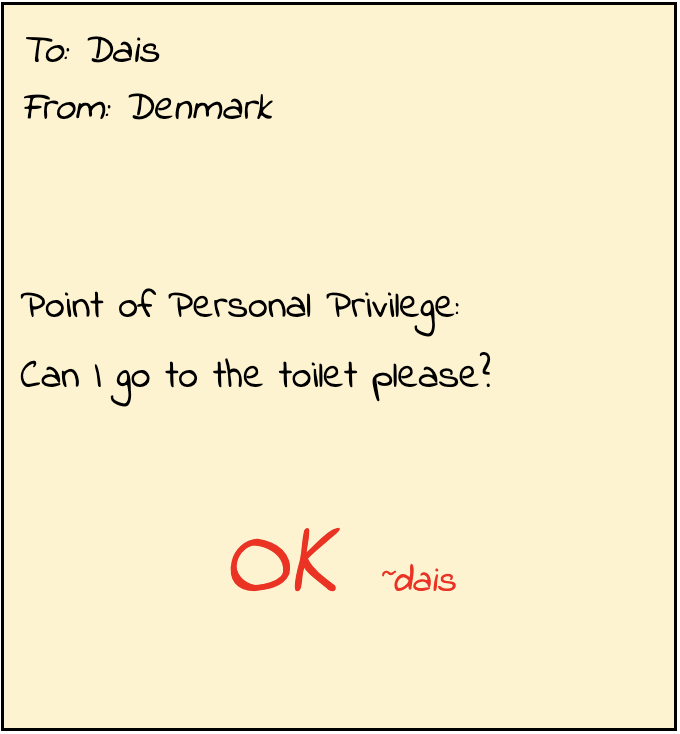
- By writing a note to the Dais
Use your own judgement on how disruptive your request will be. For example, if you wish to use the toilet, it may be best to write a note to the Dais rather than raising a point verbally between speeches.
Here are some common use cases for the POPP.
Audibility
You cannot hear the delegate who is speaking — perhaps they are speaking too softly, or too fast. You can interrupt their speech with a Point of Personal Privilege, requesting the speaker to be louder, or slower, etc.
Temperature
Suppose the air-conditioning is too cold. You can raise this point between speeches to request for the air-conditioning to be turned up. I suggest raising this point verbally, so that other delegates can concur or disagree. This request affects everyone, after all.
Toilet break
If you really need the toilet, you can write a note to the Dais to ask for permission. This affects no one else but you, so it is good manners to raise this point through notepaper. You don’t need to publicise your request for excretory relief to the entire council as this is not primary school.
Point of Order
Used to call out the Dais if they perform a wrong action.
The Point of Order (POO) is used when the Dais has deviated from the Rules of Procedure without declaring their discretion.
- Between speeches only
In practice, this point is considered rude. Raise a Point of Parliamentary Inquiry instead.
A decision of the Dais that often goes against the Rules of Procedure.
If the Dais wishes to make a decision that goes against the ROP, they must state that their decision is made by their discretion.
Point of Parliamentary Inquiry
Used to ask a clarifying question to the Dais.
The Point of Parliamentary Inquiry (POPI) is used to ask a clarifying question to the Dais.
- Between speeches
- By writing a note to the Dais
This point is the most common point used by beginner delegates. You can ask about anything relevant.
Right to Reply
Used to request an apology from another delegate if they personally attack you.
The Right to Reply is used to request for a formal apology from another delegate. You can raise a Right to Reply if another delegate communicates a personal attack to your person.
What constitutes a "personal attack to your person" is dependent on the MUN — read the Rules of Procedure. Most MUNs do not count attacks on your role as a technically-fictional delegate in the technically-fictional debate (compared to attacking you as a person). However, SMUN 2025's ROP says otherwise, so I’m just putting this here.
- Directly after the offending speech only — you have to wait for the delegate’s speech to finish before raising the Right to Reply.
Delegate A throws a personal attack at delegate B during their speech on the GSL.
A: Delegate B must have come from a lousy school — he’s illiterate! His proposed solution is absolutely terrible!
Delegate B is offended. However, delegate B must wait for delegate A’s speech to conclude before raising the Right to Reply.
A: This delegate yields their time back to the Dais.
Dais: Thank you, Delegate A.
[B immediately raises their placard.]
B: Point!
Dais: Delegate B, you have been recognised. What is your point?
B: Right to reply.
Dais: That is in order.
Delegate B must now give a reason why they raised the Right to Reply.
Dais: What is the reason for the Right to Reply?
B: Delegate A attacked me personally during the speech, making an offensive statement about my school and my literacy.
The Dais finds delegate B’s reason valid.
Dais: Delegate A, please apologise to delegate B.
A: This delegate would like to apologise to delegate B.
Dais: If this happens again, delegate A, you may be subject to disciplinary action by the Secretariat.
Delegate A throws a personal attack at delegate B during their speech on the GSL.
A: Country B has extremely low literacy levels. How can delegate B propose a solution that assumes every citizen is literate?
Delegate B is offended. However, delegate B must wait for delegate A’s speech to conclude before raising the Right to Reply.
A: This delegate yields their time back to the Dais.
Dais: Thank you, Delegate A.
[B immediately raises their placard.]
B: Point!
Dais: Delegate B, you have been recognised. What is your point?
B: Right to reply.
Dais: That is in order.
Delegate B must now give a reason why they raised the Right to Reply.
Dais: What is the reason for the Right to Reply?
B: Delegate A attacked the citizens of this delegate's country for being highly illiterate.
The Dais does not find delegate B’s reason valid. This is because delegate A did not verbally attack delegate B’s person.
Dais: That is not a valid reason.